
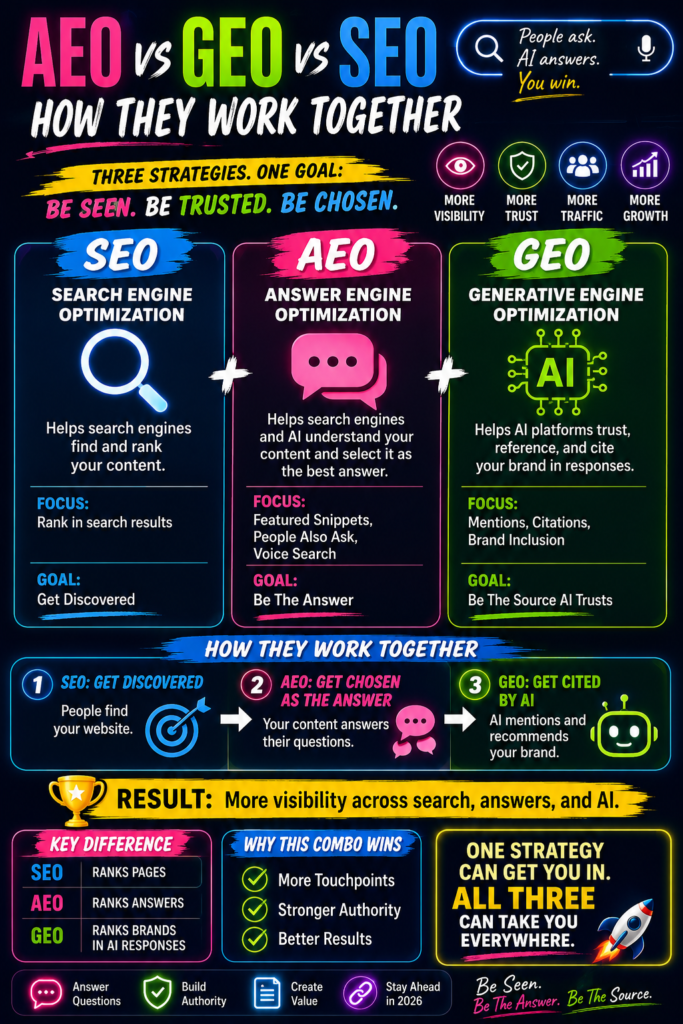
SEO gets you found. AEO gets you answered. GEO gets you mentioned by AI.
For years, digital marketing had one dominant question:
“How do I rank higher on Google?”
Today, that question is no longer enough.
People are searching differently. They are asking complete questions, expecting instant answers, using voice search, and turning to AI platforms to research products, compare businesses, and discover solutions.
That has created three powerful strategies:
SEO—Search Engine Optimization
AEO—Answer Engine Optimization
GEO — Generative Engine Optimization
But here’s the important part:
They aren’t competitors. They are three layers of the same visibility strategy.
If you understand how they work together, you can build a brand that isn’t just visible in search — but visible wherever your audience is looking for answers.
SEO, AEO, and GEO: What’s the Difference?
Let’s make it simple.
SEO: “Find Me.”
SEO helps search engines understand your website and determine where it should appear in search results.
Its traditional goals include
Higher rankings
More organic traffic
Better visibility
More clicks
More conversions
For example, you might optimize your website for:
“digital marketing services in Thrissur.”
Someone searches the phrase, your page appears, and they click.
SEO wins the discovery stage.
AEO: “Answer Me.”
AEO focuses on questions.
Instead of simply targeting:
“digital marketing services”
You might create content answering:
“What does a digital marketing analyst do?”
or:
“How can a small business increase website traffic?”
The objective is to provide a direct, useful answer that search engines and answer systems can easily understand and potentially surface.
AEO is particularly relevant to:
Featured snippets
People Also Ask
Voice search
Question-based searches
Conversational queries
Direct-answer experiences
SEO gets you into the search. AEO helps you become the answer.
GEO: “Mention Me.”
Now we enter the AI era.
GEO—Generative Engine Optimization—focuses on improving the likelihood that your brand, expertise, or content is referenced within AI-generated responses.
Imagine someone asks an AI platform:
“Who are the best digital marketing specialists for small businesses?”
Instead of displaying ten blue links, the system may generate a conversational response using information gathered from multiple sources.
The goal of GEO is to build the kind of relevance, authority, credibility, and digital presence that makes your brand worthy of being included.
**SEO gets you discovered.
AEO gets you selected as an answer.
GEO gets you into the AI conversation.
Why You Need All Three in 2026
Imagine your customer journey as a funnel.
Stage 1: Discovery
Someone searches Google.
SEO helps them discover your website.
↓
Stage 2: Questions
They want to understand something.
AEO helps your content answer their question.
↓
Stage 3: Decision
They ask an AI platform to compare options or recommend solutions.
GEO helps your brand build the visibility and authority needed to potentially appear in that AI-generated discovery.
This creates a powerful ecosystem:
Search → Answer → AI Recommendation
And your brand can be present at every stage.
The Real Difference: Three Different Goals
Strategy Main Goal: Think
SEO: gets discovered. “Find me.”
AEO provides the answer “Ask me.”
GEO Become an AI-referenced source: “Mention me.”
But these strategies overlap.
Strong SEO can help your content become discoverable.
Strong content can support AEO.
High-quality, authoritative content can contribute to GEO visibility.
The foundation is still great content.
How SEO, AEO, and GEO Work Together
Let’s say you own a digital marketing website.
You publish an article:
“How to Grow Your Business on Instagram in 2026.”
Step 1: SEO
You optimize the article around relevant search intent.
You improve:
Title
Headings
Internal links
Metadata
Content quality
Website experience
Relevant keywords
Now search engines can discover and understand your page.
SEO → Visibility
Step 2: AEO
You add questions people actually ask:
How often should a business post on Instagram?
What type of content gets more engagement?
How can small businesses grow on Instagram?
Then provide concise answers before expanding on them.
AEO → Answers
Step 3: GEO
Now go deeper.
Add:
Original insights
Data
Examples
Case studies
Expert commentary
Credible references
Unique frameworks
Build related content across your website.
Earn relevant brand mentions and citations.
Now your content isn’t simply another article.
It becomes a useful source of information.
GEO → Authority and AI visibility
The Secret Is Not More Content. It’s Better Content.
One of the biggest mistakes brands make is thinking:
“If I publish 100 AI-generated articles, I’ll dominate AI search.”
Not necessarily.
More content does not automatically mean more authority.
Imagine two websites.
Website A
Publishes 500 generic articles with repetitive information.
Website B
Publishes 50 highly useful articles containing original research, practical examples, expert insights, and credible references.
Which one would you trust?
The answer is obvious.
In the AI era, information quality matters more than content volume.
Your objective shouldn’t be to produce more.
It should be to produce something worth finding.
How to Build a Winning SEO + AEO + GEO Strategy
- Start With Search Intent
First, understand what your audience is looking for.
Don’t just collect keywords.
Find the questions behind them.
SEO asks, “What are people searching for?”
AEO asks, “What questions are they asking?”
GEO asks, “What information will they trust when making a decision?”
- Create Answer-First Content
Start important sections with a clear answer.
Don’t make readers dig through 500 words to discover your point.
Use:
Question → Answer → Explanation → Example
This structure is useful for both humans and search systems.
- Build Topic Clusters
Don’t publish disconnected articles.
Build content around a central topic.
For example:
SEO
→ Technical SEO
→ Local SEO
→ Content SEO
→ AEO
→ GEO
→ AI Search
→ Search Intent
→ Topical Authority
Link related content together.
This creates a stronger knowledge ecosystem around your brand.
- Create Original Information
This is where GEO becomes particularly interesting.
Instead of repeating:
“Content is king.”
Show something new.
Conduct a survey.
Publish your own findings.
Share a case study.
Analyze a campaign.
Create a unique framework.
Provide original statistics.
If everyone is saying it, you’re not giving AI much reason to choose you.
Originality gives your brand something distinctive to contribute.
- Build Authority Beyond Your Website
Your website is only one part of your digital identity.
Your brand may also appear through:
Industry publications
Interviews
Podcasts
Professional profiles
Relevant directories
Reviews
Guest contributions
Third-party articles
Social platforms
The goal isn’t random backlinks or meaningless mentions.
The goal is credible digital recognition.
- Make Your Brand Consistent
Your website says one thing.
Your social media says another.
A directory contains outdated information.
Your author profile has no expertise information.
This creates a fragmented digital identity.
Keep important information consistent:
Who you are.
What you do.
Who you serve.
Where you operate.
What you specialize in.
A clear digital identity makes your brand easier to understand.
- Keep Updating Your Content
Search doesn’t stand still.
Neither does AI.
Information becomes outdated.
Statistics change.
Tools evolve.
Consumer behavior shifts.
That means your content should evolve too.
Review important pages regularly.
Update outdated information.
Add new examples.
Improve weak sections.
Refresh statistics.
Don’t just publish and forget. Publish, learn, update, and improve.
The Future of Search Isn’t SEO vs. AEO vs. GEO
This is the biggest misconception.
You don’t have to choose one.
The future is SEO + AEO + GEO.
Think of them as three doors into the same brand.
🚪 SEO: People discover you.
🚪 AEO: People get answers from you.
🚪 GEO: AI systems can recognize and potentially reference your expertise.
Together, they create multiple opportunities for your brand to appear throughout the modern search journey.
The New Digital Marketing Formula
The old formula was
Keyword → Ranking → Click → Conversion
The new search environment is becoming more complex:
Question → Search → Answer → AI Discovery → Trust → Decision
And brands need to be prepared for every stage.
That’s why your content strategy should no longer ask only:
“How can I rank this page?”
Ask:
“How can I make this page the best answer?”
Then ask:
“What makes my information credible enough to be referenced?”
And finally:
“How can my brand become recognizable across the entire search journey?”
The Bottom Line
SEO, AEO, and GEO aren’t three separate trends.
They are three parts of a much bigger transformation in digital discovery.
SEO helps you get found.
AEO helps you become the answer.
GEO helps your brand become part of AI-powered discovery.
The brands that understand this shift early won’t simply compete for rankings.
They’ll compete for answers, mentions, citations, recommendations, and trust.
So don’t choose between SEO, AEO, and GEO.
Build all three.
Be discovered.
Be the answer.
Be the source.
Because in 2026, the biggest digital marketing win may not be being #1 on Google.
It may be becoming the brand people—and AI—remember when the question is asked. AEO vs GEO vs SEO: How They Work Together to Make Your Brand Impossible to Ignore
SEO gets you found. AEO gets you answered. GEO gets you mentioned by AI.
For years, digital marketing had one dominant question:
“How do I rank higher on Google?”
Today, that question is no longer enough.
People are searching differently. They are asking complete questions, expecting instant answers, using voice search, and turning to AI platforms to research products, compare businesses, and discover solutions.
That has created three powerful strategies:
SEO—Search Engine Optimization
AEO—Answer Engine Optimization
GEO — Generative Engine Optimization
But here’s the important part:
They aren’t competitors. They are three layers of the same visibility strategy.
If you understand how they work together, you can build a brand that isn’t just visible in search but visible wherever your audience is looking for answers.
SEO, AEO, and GEO: What’s the Difference?
Let’s make it simple.
SEO: “Find Me.”
SEO helps search engines understand your website and determine where it should appear in search results.
Its traditional goals include
Higher rankings
More organic traffic
Better visibility
More clicks
More conversions
For example, you might optimize your website for:
“digital marketing services in Thrissur.”
Someone searches the phrase, your page appears, and they click.
SEO wins the discovery stage.
AEO: “Answer Me.”
AEO focuses on questions.
Instead of simply targeting:
“digital marketing services”
You might create content answering:
“What does a digital marketing analyst do?”
or:
“How can a small business increase website traffic?”
The objective is to provide a direct, useful answer that search engines and answer systems can easily understand and potentially surface.
AEO is particularly relevant to:
Featured snippets
People Also Ask
Voice search
Question-based searches
Conversational queries
Direct-answer experiences
SEO gets you into the search. AEO helps you become the answer.
GEO: “Mention Me.”
Now we enter the AI era.
GEO—Generative Engine Optimization—focuses on improving the likelihood that your brand, expertise, or content is referenced within AI-generated responses.
Imagine someone asks an AI platform:
“Who are the best digital marketing specialists for small businesses?”
Instead of displaying ten blue links, the system may generate a conversational response using information gathered from multiple sources.
The goal of GEO is to build the kind of relevance, authority, credibility, and digital presence that makes your brand worthy of being included.
**SEO gets you discovered.
AEO gets you selected as an answer.
GEO gets you into the AI conversation. **
Why You Need All Three in 2026
Imagine your customer journey as a funnel.
Stage 1: Discovery
Someone searches Google.
SEO helps them discover your website.
↓
Stage 2: Questions
They want to understand something.
AEO helps your content answer their question.
↓
Stage 3: Decision
They ask an AI platform to compare options or recommend solutions.
GEO helps your brand build the visibility and authority needed to potentially appear in that AI-generated discovery.
This creates a powerful ecosystem:
Search → Answer → AI Recommendation
And your brand can be present at every stage.
The Real Difference: Three Different Goals
Strategy Main Goal: Think
SEO: Get discovered. “Find me.”
AEO provides the answer “Ask me.”
GEO Become an AI-referenced source: “Mention me.”
But these strategies overlap.
Strong SEO can help your content become discoverable.
Strong content can support AEO.
High-quality, authoritative content can contribute to GEO visibility.
The foundation is still great content.
How SEO, AEO, and GEO Work Together
Let’s say you own a digital marketing website.
You publish an article:
“How to Grow Your Business on Instagram in 2026.”
Step 1: SEO
You optimize the article around relevant search intent.
You improve:
Title
Headings
Internal links
Metadata
Content quality
Website experience
Relevant keywords
Now search engines can discover and understand your page.
SEO → Visibility
Step 2: AEO
You add questions people actually ask:
How often should a business post on Instagram?
What type of content gets more engagement?
How can small businesses grow on Instagram?
Then provide concise answers before expanding on them.
AEO → Answers
Step 3: GEO
Now go deeper.
Add:
Original insights
Data
Examples
Case studies
Expert commentary
Credible references
Unique frameworks
Build related content across your website.
Earn relevant brand mentions and citations.
Now your content isn’t simply another article.
It becomes a useful source of information.
GEO → Authority and AI visibility
The Secret Is Not More Content. It’s Better Content.
One of the biggest mistakes brands make is thinking:
“If I publish 100 AI-generated articles, I’ll dominate AI search.”
Not necessarily.
More content does not automatically mean more authority.
Imagine two websites.
Website A
Publishes 500 generic articles with repetitive information.
Website B
Publishes 50 highly useful articles containing original research, practical examples, expert insights, and credible references.
Which one would you trust?
The answer is obvious.
In the AI era, information quality matters more than content volume.
Your objective shouldn’t be to produce more.
It should be to produce something worth finding.
How to Build a Winning SEO + AEO + GEO Strategy
- Start With Search Intent
First, understand what your audience is looking for.
Don’t just collect keywords.
Find the questions behind them.
SEO asks, “What are people searching for?”
AEO asks, “What questions are they asking?”
GEO asks, “What information will they trust when making a decision?”
- Create Answer-First Content
Start important sections with a clear answer.
Don’t make readers dig through 500 words to discover your point.
Use:
Question → Answer → Explanation → Example
This structure is useful for both humans and search systems.
- Build Topic Clusters
Don’t publish disconnected articles.
Build content around a central topic.
For example:
SEO
→ Technical SEO
→ Local SEO
→ Content SEO
→ AEO
→ GEO
→ AI Search
→ Search Intent
→ Topical Authority
Link related content together.
This creates a stronger knowledge ecosystem around your brand.
- Create Original Information
This is where GEO becomes particularly interesting.
Instead of repeating:
“Content is king.”
Show something new.
Conduct a survey.
Publish your own findings.
Share a case study.
Analyze a campaign.
Create a unique framework.
Provide original statistics.
If everyone is saying it, you’re not giving AI much reason to choose you.
Originality gives your brand something distinctive to contribute.
- Build Authority Beyond Your Website
Your website is only one part of your digital identity.
Your brand may also appear through:
Industry publications
Interviews
Podcasts
Professional profiles
Relevant directories
Reviews
Guest contributions
Third-party articles
Social platforms
The goal isn’t random backlinks or meaningless mentions.
The goal is credible digital recognition.
- Make Your Brand Consistent
Your website says one thing.
Your social media says another.
A directory contains outdated information.
Your author profile has no expertise information.
This creates a fragmented digital identity.
Keep important information consistent:
Who you are.
What you do.
Who you serve.
Where you operate.
What you specialize in.
A clear digital identity makes your brand easier to understand.
- Keep Updating Your Content
Search doesn’t stand still.
Neither does AI.
Information becomes outdated.
Statistics change.
Tools evolve.
Consumer behavior shifts.
That means your content should evolve too.
Review important pages regularly.
Update outdated information.
Add new examples.
Improve weak sections.
Refresh statistics.
Don’t just publish and forget. Publish, learn, update, and improve.
The Future of Search Isn’t SEO vs AEO vs GEO
This is the biggest misconception.
You don’t have to choose one.
The future is SEO + AEO + GEO.
Think of them as three doors into the same brand.
🚪 SEO: People discover you.
🚪 AEO: People get answers from you.
🚪 GEO: AI systems can recognize and potentially reference your expertise.
Together, they create multiple opportunities for your brand to appear throughout the modern search journey.
The New Digital Marketing Formula
The old formula was:
Keyword → Ranking → Click → Conversion
The new search environment is becoming more complex:
Question → Search → Answer → AI Discovery → Trust → Decision
And brands need to be prepared for every stage.
That’s why your content strategy should no longer ask only:
“How can I rank this page?”
Ask:
“How can I make this page the best answer?”
Then ask:
“What makes my information credible enough to be referenced?”
And finally:
“How can my brand become recognizable across the entire search journey?”
The Bottom Line
SEO, AEO, and GEO aren’t three separate trends.
They are three parts of a much bigger transformation in digital discovery.
SEO helps you get found.
AEO helps you become the answer.
GEO helps your brand become part of AI-powered discovery.
The brands that understand this shift early won’t simply compete for rankings.
They’ll compete for answers, mentions, citations, recommendations, and trust.
So don’t choose between SEO, AEO, and GEO.
Build all three.
Be discovered.
Be the answer.
Be the source.
Because in 2026, the biggest digital marketing win may not be being #1 on Google.
It may be becoming the brand people—and AI—remember when the question is asked.
For businesses aiming to grow their digital presence, a Freelance Digital Marketing Analyst in Thrissur can combine SEO, AEO, and GEO to improve visibility across both traditional and AI-powered search.